
Short answer
This article explains how to accommodate children, the elderly, neurodivergent participants, and people with different sound sensitivities. Its practical model covers volume, seating, a clear exit route, transparent evidence and regular review.
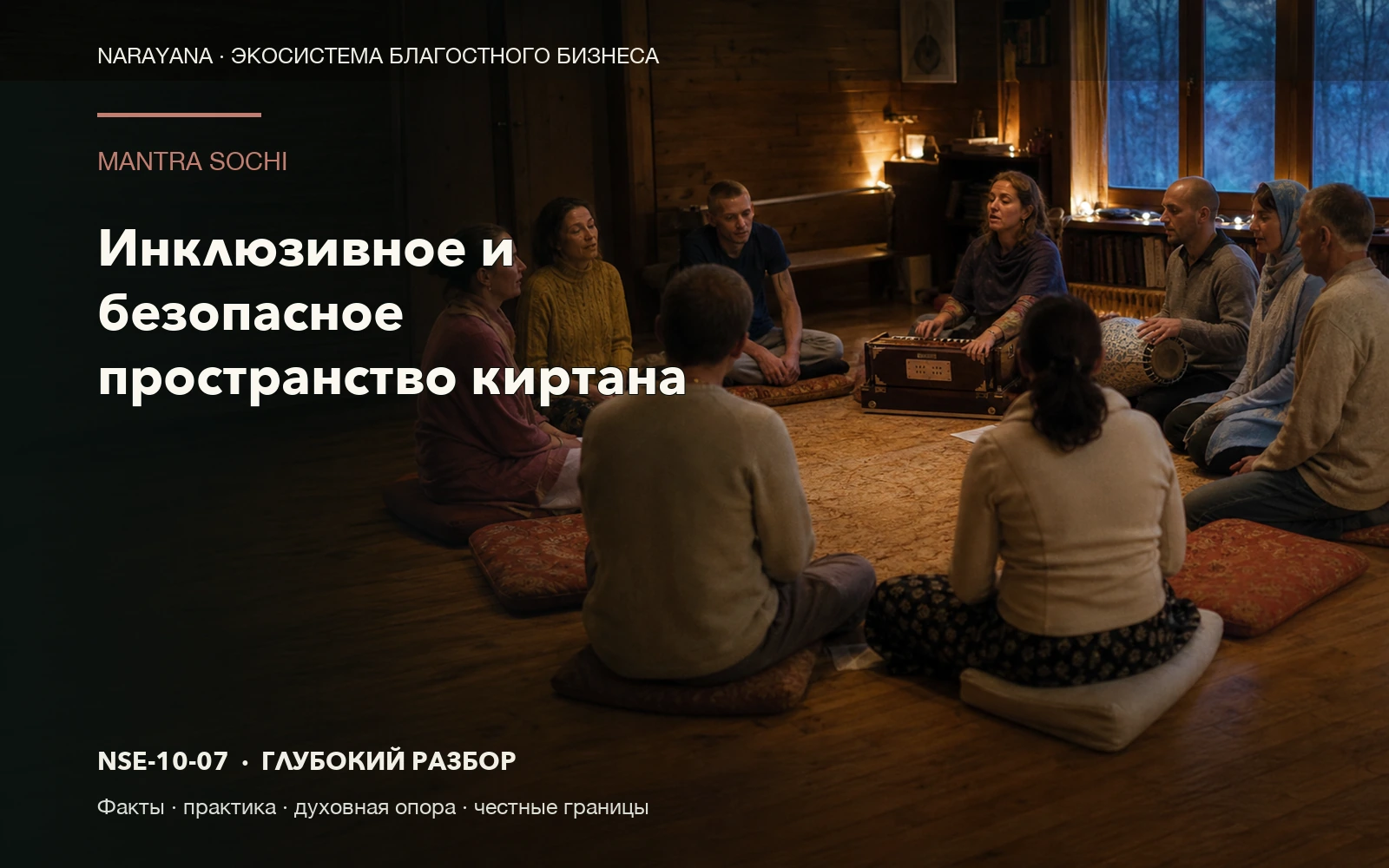
An Inclusive, Safe Kirtan Space deserves more than a branding treatment; it raises the practical question of how to accommodate children, older adults, neurodivergent participants, and people with different sound sensitivities. Within Mantra Sochi, the topic connects directly to the mission: to create an accessible space in Sochi for communal singing, attentive listening, bhakti practice and human connectedness without the pressure to conform. If it remains only inspirational, the idea becomes little more than an attractive slogan. Expressed through criteria, roles, data, and regular review, it can become part of a living system that serves people.
Why is this question important now?
The public page brings together live kirtans, bhakti courses, mantra evenings, walks, and an urban community. It places particular emphasis on gentle inclusion: no one needs a trained or ‘perfect’ voice to take part. This should be understood as a proposed operating model, not as evidence that every element has reached the same level of maturity. A professional approach distinguishes among an idea, a working prototype, a verified result, and a scalable standard. That is why the central question of the article is: how to take into account children, older adults, neurodivergent participants, and people with different sound sensitivities?
A five-part model
1. Volume: Determine why the solution exists. In the theme “Inclusive and Safe Kirtan Space”, the first element establishes a practical criterion of value rather than a polished declaration. The team must identify whose situation should change and what improvement would count as success. At the same time, the team defines an early warning sign: when does the practice of “loudness” serve the convenience of the system, status, or reporting rather than the person? This dual definition—the desired outcome and the observable counterexample—makes the design testable and protects the mission from being replaced by activity.
2. Landing: Integrate the principle into operational work. The boarding element must have an owner, a decision point and a place in the participant's route. The team should describe a specific handoff rather than a job title: who notices the signal, who talks to the person, who has the right to change the scenario and where the agreement is recorded. For Mantra Sochi, maturity manifests itself when the appropriate response does not depend on a single visionary and can be reproduced by an ordinary team on a busy day.
3. Exit Route: Select a proof commensurate with the promise. For the Exit Route element, overall team satisfaction is not sufficient. At a minimum, three layers are needed: the fact of the process being performed, the person's experience, and an outcome that can be reasonably linked to the action without overstating causation. Numbers are not inherently stronger than conversation: logs, observation, and structured interviews can complement quantitative metrics. But the source, date and method of collection must be visible, and negative and ambiguous signals must not disappear from the report.
4. Information in advance: state the conflict and limit in advance. Almost every good decision has a price and a competing value. Know-in-advance practices may require more time, limit rapid growth, or make the offering less general. A professional model does not hide this tradeoff: it defines red lines, exceptions, a responsible person and a way to communicate the limitation before a person decides. This is where ethics becomes architecture rather than intent.
5. Support Person: Turn experience into learning for the system. The Support Person element completes the cycle: the team sets a review date, compares expectations with actual results, and decides what to keep, change, or stop. Each change receives a version, a rationale, and a clear path into practice—to a standard, training module, property record, or access rule. This is how Mantra Sochi can grow without losing memory: it is not the slogan that scales, but the proven ability to see the consequences and improve the work.
What international sources can—and cannot—support
The WHO report examines social connectedness as a driver of health, community resilience, education and the economy, and outlines scalable interventions to strengthen connections. For the topic of this article, this is not a ready-made recipe, but an external guide: a strong statement must be proportionate to the data, the context, and the risk of error.
A systematic review of group singing notes promising social and psychological effects, while highlighting the heterogeneity of studies and the need for cautious conclusions. For the topic of this article, this is not a ready-made recipe, but an external guide: a strong statement must be proportionate to the data, the context, and the risk of error.
The WHO review links quality green spaces to physical activity, alertness, social interaction and reduced exposure to a range of urban stressors. For the topic of this article, this is not a ready-made recipe, but an external guide: a strong statement must be proportionate to the data, the context, and the risk of error.
How to apply this in Narayana
A first-time participant arrives without knowing the words, unsure of their voice, and free to observe. The quality of the space is reflected in whether they can join without pressure and leave feeling respected. In this situation, the article's central question—how to take into account children, older adults, neurodivergent participants, and people with different sound sensitivities—becomes a specific management task. The practice cycle begins with the loudness element: the team records the initial state and formulates one testable change. Through the “boarding route,” responsibility is assigned, and through the “exit route,” evidence is selected that will be collected without violating dignity and privacy. The “information in advance” element sets the boundary for intervention and honest communication to the participant. Finally, the “support person” turns the result into a decision about further use. The debriefing compares the promise, actual experience, costs, side effects, and remaining uncertainty. The team can then choose one of four outcomes: maintain, improve, expand, or stop. All four are mature decisions; the only immature choice is to present an untested claim as proven.
Practical next steps
- Define in one sentence what “loudness” means for an individual—not for a presentation.
- Assign a result owner and data source for the “landing” element.
- Describe the minimum safe pilot to test the exit route element.
- Establish a promise boundary and renegotiation criterion for the information in advance element in advance.
- Review the consequences openly and record the next step on the “support person” element.
Spiritual and ethical foundation
The spiritual reference here is Bhagavad Gita 17.15. In an applied reading, its meaning can be expressed as follows: Speech should be truthful, helpful, considerate, and delivered with respect. This is neither decoration nor a claim that a decision is infallible. On the contrary, the spiritual principle raises the standard: we are obliged to tell the truth about the stage of the project, respect human freedom, not exploit vulnerability and accept the consequences of our own decisions. Service manifests itself in the quality of ordinary work—in an accurate promise, reliable data, a fair agreement and a willingness to correct a mistake.
Honest limitations
This model does not promise medical outcomes, guaranteed profitability, automatic professional status, or the same outcome for every person or property. External studies describe patterns and frameworks, but do not confirm a specific Narayana result without Narayana's own data. Legal, medical, investment and technical decisions require review by qualified professionals. Where there is insufficient data, the honest wording is “hypothesis”, “pilot” or “status under review”.
Conclusion
The value of "An Inclusive and Safe Kirtan Space" is measured not by the number of inspiring words, but by Mantra Sochi's ability to make value repeatable, verifiable, and humane. When a mission is translated into a clear process, it does not lose spiritual depth—it gains a form through which it can serve longer. The next mature step is to select one element of the model, test it on a small scale, and publicly distinguish between intent, fact, and outcome.
Ecosystem initiative
Learn more and follow this initiative: Mantra Sochi ↗.
Factual basis
Sources and further reading
- WHO Commission on Social Connection — From loneliness to social connection ↗
- Public Health — Systematic review of group singing and wellbeing ↗
- WHO Europe — Urban green spaces and health ↗
The sacred text is used as a philosophical framework, not as a substitute for scientific, legal, or medical evidence.